The first thing worth understanding about the most exclusive golf clubs in the world is that money is often not enough.
A net worth in the hundreds of millions will get you past the front door of most private members clubs, but not these ones. The clubs on this list operate on a different set of rules, where who you know, who you are, and how long you are willing to wait matters considerably more than what you can afford to spend. Several of them have no public membership fee because they have no interest in telling you what it costs. If you have to ask, the answer is probably no.
Augusta National Golf Club, Georgia

Augusta is the most famous private golf club in the world and the one most people will never set foot in unless they are watching the Masters on television. The membership sits at around 300 people, the full list of which has never been made public, and the number is kept deliberately small. Membership is strictly by invitation, and the fastest way to guarantee you are never asked is to make it known that you want to be. The club does not discuss fees, waiting lists, or criteria. What is known is that members are not permitted to speak publicly about club policy. In 2012, Augusta admitted its first female members after decades of pressure, and there are currently around seven women among the membership. The course, designed by Bobby Jones and Alister MacKenzie and opened in 1932, is widely considered the most perfectly maintained stretch of grass in golf.
Pine Valley Golf Club, New Jersey
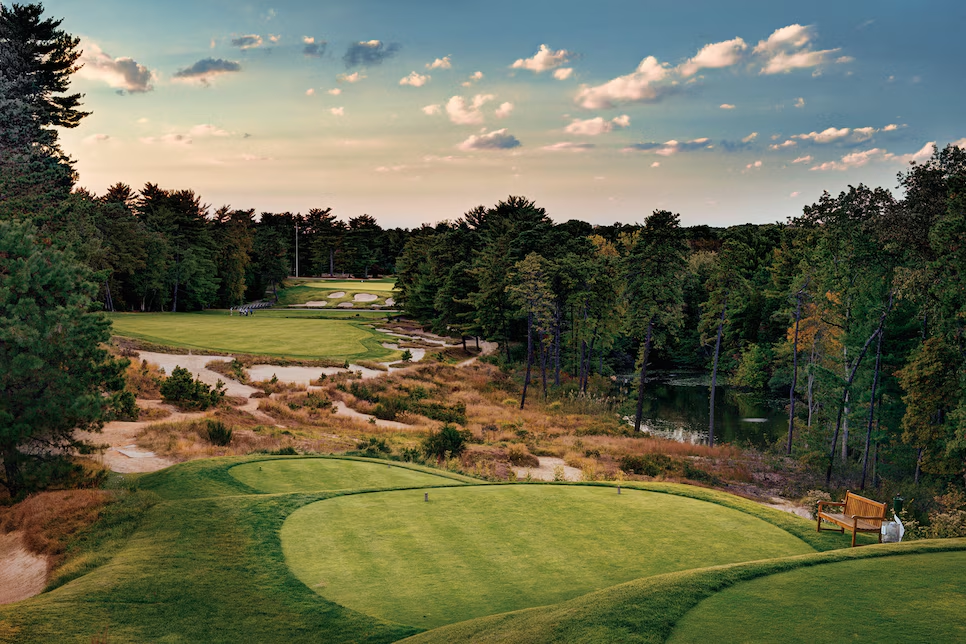
Pine Valley is consistently ranked among the top two or three courses in the world and has fewer than 1,000 members, none of whom applied to join. Membership is not open to application, full stop. You are invited, or you are not, and most people are not. Guests of members must carry a low handicap to be allowed to play, which filters out casual golfers regardless of their connections. The initiation fee is believed to be upwards of $100,000 with annual dues around $10,000, though the club does not confirm either figure. It was founded in 1913 by George Crump, a Philadelphia hotelier who spent the last years of his life shaping the course out of the New Jersey pine barrens. Crump died in 1918 before it was finished.
Cypress Point Club, California

Cypress Point sits on the Monterey Peninsula in California and has 250 members, most of them prominent in politics, business or finance. An average of 30 golfers are allowed to play on any given day, making it one of the most difficult courses in the world to get a round on regardless of your membership status. The course was designed by Alister MacKenzie, the same architect behind Augusta, and runs along the Pacific Ocean with a series of holes that are regularly cited as the most visually dramatic in golf. Fees are calculated by dividing the annual running costs between the membership, however many times you actually played that year. The 16th hole, a par three that requires a carry of around 230 yards directly over the Pacific to reach a green perched on a cliff, is often cited as the single most beautiful hole in golf.
The Royal and Ancient Golf Club of St Andrews, Scotland

The R&A was founded in 1754 and has shaped golf’s rules and traditions for nearly three centuries. It does not own the Old Course at St Andrews, which is public, but the club’s role in governing the sport globally gives it a standing that no other club can match. Membership is by invitation only and the club’s preferences are not publicly stated. The waiting list is understood to be long and the membership profile leans heavily toward those with significant standing in the game, whether as administrators, amateurs of distinction, or figures with a meaningful connection to golf’s history. The club’s annual Autumn Medal is one of the oldest competitions in the sport.
Sunningdale Golf Club, Berkshire

Sunningdale is 30 miles southwest of London and has two championship courses, the Old and the New, both of which regularly feature in lists of Britain’s finest. To be considered for membership, a prospective member needs support from six existing members and is required to play a round with a committee member before their name is formally proposed. Initiation fees start above £100,000, with annual dues around £8,000. The club was founded in 1900 and the Old Course, designed by Willie Park Jr, has hosted European Tour events and a significant number of Open Championship qualifying rounds. The membership is broadly made up of senior figures from finance and business in the City of London.
Muirfield, East Lothian

Muirfield is home to the Honourable Company of Edinburgh Golfers, the oldest golf club in the world by most accounts, founded in 1744. The course has hosted the Open Championship 16 times. Membership is highly selective and the process involves a formal proposal, a ballot among existing members, and a waiting period that can run to several years. The club made headlines in 2016 when members voted against admitting women, a decision that prompted The Open to remove Muirfield from its rotation until the vote was reversed in 2017. It returned to the Open rota in 2022.
Shanqin Bay Golf Club, Hainan

Shanqin Bay in China is, by most measures, the most financially exclusive golf club on the planet. The joining fee is reported to be $1 million USD. There are approximately 20 members. The course was designed by David McLay Kidd, who also designed Bandon Dunes in Oregon, and sits on the southern coast of Hainan Island with ocean views across much of the layout. Almost nothing is publicly known about the membership process beyond the fee, which is presumably the point.
Les Bordes, Loire Valley

Les Bordes sits on a 1,400-acre estate in the Loire Valley south of Paris and is consistently ranked among the finest courses in continental Europe. It was built by Marcel Bich, the billionaire behind the Bic pen and razor company, and designed in collaboration with a Japanese industrialist friend. The course runs through oak forests and past a series of lakes, and the clubhouse, with its exposed beams, stone floors and leather chairs, feels like a private house rather than a club. Membership fees are not disclosed. The estate has since expanded to include lodges and a second course, though access remains tightly controlled.
What it actually takes
Across all of these clubs, the common thread is not money. It is connection, patience, and the right kind of reputation. Most require a formal proposal from existing members, sometimes as many as four or six, followed by a ballot or committee review. Several have waiting lists measured in years rather than months. A few have no formal process at all because they operate entirely on quiet invitation, with no mechanism for an outsider to even begin the conversation.
The unspoken rule at the very top of the list is simpler than all of that. You do not pursue membership at these clubs. You make yourself the kind of person worth inviting, and then you wait.